
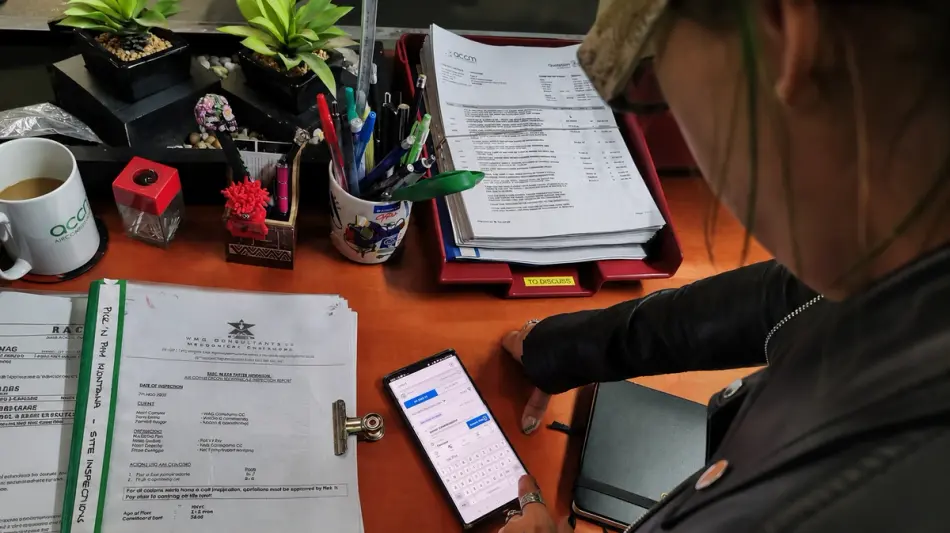
There's a pattern we see in nearly every SA trade business once it gets past five or six staff. The work is good, the team is busy, the customers keep calling. But the office has quietly become the bottleneck.
Often it's the owner's wife, or one admin, running quotes, scheduling, job cards, and invoices on their own. By 9pm most evenings they're still typing up the day's work.
It is not a sales problem. It is not a team problem. It is a system problem.
And it is almost never solved by working harder. Most owners we speak to have already tried that. The hours just shift; the pile does not shrink.
This article walks through six practical things you can change this week to stop the admin running you. No new software required. They work whether you're a plumbing contractor, an electrical operator, a security installer, or any other field service business that ends each day with paperwork.
There's also a free Field Tech Accountability SOP and an Excel quote template included that you can download and use immediately.
Why your office is always behind
When a trade business is taking off, the owner can hold everything in their head. The quote, the job, the materials, the invoice, the follow-up. Memory works fine at five jobs a week. At twenty, things start slipping through the cracks. At forty, you are losing track of one or two a day and you can't tell which.
Most growing trade businesses pass through a quiet phase where the volume has outgrown the system, but nobody has noticed yet. The team keeps doing what worked at the smaller size. The owner keeps holding everything together. The admin keeps typing.
Until one Tuesday evening at 9pm somebody realises, "this can't be our new normal".
The fix is not more hours. The fix is fewer moving parts that depend on memory. Every change below tightens one of those moving parts.
Six things to change this week
1. End every job with a 60-second sign-off ritual
The single biggest source of late-night admin is incomplete job cards. The tech finishes the job, gets in the bakkie, drives to the next site, and means to fill in the gaps later. Three jobs later, the details are fuzzy.
A 60-second sign-off ritual on site fixes most of this. Before the tech leaves the customer's premises:
- One photo of the completed work
- All materials used logged on the spot, not from memory
- Customer signature
- Arrival and departure times noted
That is the whole ritual. Sixty seconds, every job.
The discipline is not free, but it is cheaper than reconstructing a job at 8pm three days later. Job cards finished on site arrive at the office complete. Invoices go out the same day. The owner's evening starts at 5pm, not 11pm.
2. Move quoting onto a template
A free-text quote written from scratch takes 15 to 25 minutes. It also looks slightly different every time, which makes the business look less professional than it is.
A template quote takes 3 to 5 minutes. The customer sees a consistent, polished document. You don't reinvent the wheel for every callout.
The template only needs to handle:
- Customer details
- Job description
- Labour and materials line items
- Total, ex-VAT and inc-VAT, with payment terms
- Signature block
Any tool that holds those five things consistently works. Excel, Word, Google Sheets, whatever the team will actually open.
If you don't have a template you like, here is one built for South African trade businesses. Auto-calculating line items, VAT at 15%, a banking details block for EFT payments, a deposit-and-balance split, and a customer acceptance signature. Use it as-is or customise it to your business. It is yours to keep.
3. Quote at the customer's door, not back at the office
The quote you send three days after the site visit converts far less well than the quote you send within the hour. Industry research is even more dramatic than that: contractors who respond within 60 minutes are several times more likely to close than those who wait a day or more. Customers shop around in those three days. They lose interest. They forget the urgency they felt when you were standing in their kitchen, garage, or driveway with a problem they want gone today.
The fix is to quote before you have left the driveway. Phone, tablet, or laptop. Template open. Numbers in. Send.
This sometimes feels like it slows the job, but it speeds the cash. A quote sent same-day converts faster, gets fewer "let me think about it" replies, and avoids the three-day shop-around window where the customer is comparing other options.
If the tech is doing the quoting, give them the template and the confidence to use it. Most techs are perfectly capable of pricing a job within 15% of what the office would charge, especially once the template anchors the line items.
4. One materials confirmation point, not five
A common pattern: the tech leaves the depot, gets to site, realises something is missing, drives back to the depot, drives back to site. Or worse, arrives at site without something critical and has to call the office, who has to call the supplier, who has to confirm stock.
The fix is one materials check, in one place, before the tech leaves the depot. Not on the way. Not at the customer's door. Before the wheels roll.
A simple pre-departure checklist works. The depot manager (or the tech themselves) reads the job brief, pulls the materials list, confirms availability, signs off, and only then does the tech leave.
It feels like an extra step in the morning. It saves an hour of driving and a phone call to the office every other day.
5. Create a daily drumbeat the team trusts
Most teams don't fail because they don't care. They fail because they don't know what is expected and when.
Set a daily drumbeat. Three fixed times. Same every day. The team learns to plan around them.
- 7am: tomorrow's job briefs sent to techs.
- 5pm: today's job cards submitted by techs.
- 9am the next day: office reviews and invoices anything from yesterday.
That is the whole drumbeat. Three times, every day. Repeat for three weeks.
Once the team trusts the drumbeat, the chasing stops. The office knows when to expect what. The techs know when to deliver it. The owner stops being the human task-manager moving information from one person to another.
Three fixed times. No exceptions. Don't move them unless you absolutely have to.
6. Print the Field Tech Accountability SOP
We have pulled the discipline behind every tip above into a one-page Field Tech Accountability SOP. It covers what every tech logs on arrival, during the job, and before they leave. It also covers what the office commits back: briefing on time, materials confirmed before departure, payment chasing handled by admin and not by techs.
Print one copy for each bakkie. Stick one on the office wall. Run a 10-minute team meeting walking through it. Most teams running it see cleaner job cards within the first week.
When workflow changes are not enough
The six tips above will buy you time. Most trade business owners we work with find them genuinely useful, and most can implement at least three of them inside a week.
But there is a threshold where workflow tweaks stop being enough.
Usually it is somewhere between five and twelve staff. At that point, you have multiple teams and more jobs running simultaneously than any spreadsheet, paper diary, or whiteboard can hold cleanly. The office becomes the bottleneck not because the process is broken, but because the volume has outgrown the tools you are using to run it.
This is the point where most growing trade businesses move onto a proper operating system. Not because they want to add another tool, but because they need the job, the materials, the customer record, the quote, the invoice, and the team's location to all live in one place.
If you have tried the tips above and your office is still drowning by 8pm, that is the signal.
ServCraft is the operating system 1,000+ SA trade businesses already run on. We also run , our free training programme for SA trade business owners, co-hosted with industry partners Plumblink, ARB Electrical Wholesalers, Elvey Security, and ZKTECO.
ServCraft Mastery Events
If you would like to see what ServCraft looks like for a business your size, with one of our experts today.
book a consultation