
The short answer:
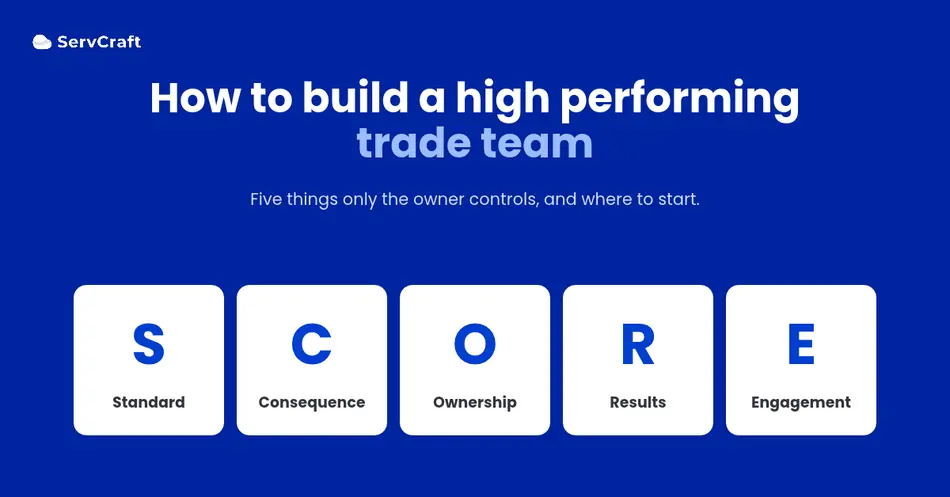
a high performing trade team does the work to a known standard without the owner in the middle of it. Five things decide whether yours does, and all five sit with you: the standard you set, the consequence you apply, the ownership you hand over, the numbers your team can see, and the feedback you give. This guide comes from a live ServCraft Mastery session with Kyle Thompson of 24Seven Plumbing and Electrical, Leander Opperman of Unlok Consulting and ServCraft CEO Charles Freedman.Kyle's first process was simple. The phone rang, he pointed a team at the job, put it in Google Calendar and hoped there would be no callback. When he finally measured the teams, productivity was under 30%. Nobody was slacking on purpose. Nobody had been told what good looked like. As Charles put it in the session, your team is performing exactly as well as you have set it up to perform.
Where teams go wrong
Most trade owners are good at the trade and learn leadership on the job. The same problems show up again and again:
- Quick changes nobody follows.Kyle took over a business carrying debt and changed things fast. "No one was following," he said. What worked was sitting down with each team, explaining where the business stood and building the action plan together.
- Standards that live in your head.Leander calls it the curse of knowledge: you hear the song, and your technician hears nothing.
- Mistakes that get hidden.If people fear the response, problems surface a year later.
- Everything routes through you.It is quicker to give the answer, but each time you do, people offer fewer ideas.
- Numbers nobody sees.Targets that sit in the owner's spreadsheet change nothing on site.
If two or more sound familiar, SCORE is a good place to start.
Five things to get right
1. Standard: write down what good looks like
If good is not defined, it becomes opinion. Leander's exercise: pick five jobs your team repeats, write five bullet points for each, then ask a technician to describe the standard back to you. The gaps show you what was only in your head. Leander cited an insurance team that lifted productivity by 18% in nine weeks once standards were defined and measured.
Kyle's version: a stock and tool list for every vehicle (technicians were sharing one drill between vans), different standards for maintenance, specialised services and construction, and the cost of running each team per day, which sets a weekly revenue target. "You can't make decisions on thumb suck." Quotes go out within 24 hours and the callback target is 1.5%.
2. Consequence: apply it to the work, not the person
Once the standard is clear, accountability is fair. Praise good work in front of others, correct poor work in private, and apply the same rule to your best technician. Leander's line: be hard on the issue and soft on the person. Charles added that a consequence should be human and unsurprising, because the person already knew the standard.
Kyle's example from the day of the session: a technician under-quoted a job and phoned him straight away. He lost his on-call week, stayed to see the job through and apologised to the client. He was held accountable and was not punished for owning up.
3. Ownership: ask before you tell
When someone says "boss, there is a problem", ask "what would you do?" If it is safe, let them try it and report back. Leander calls this coaching. Kyle tested it by taking five weeks off. Things cracked, his teams put them back together quickly, and some key accounts now phone the team instead of him.
Lack of urgency in a team usually traces back to the first two items. Was the standard clear, and were the consequences understood?
4. Results and visibility: measure what people can influence
Kyle's maintenance teams carry a daily jobs target (which sets invoiceable hours), a materials percentage, a minimum of four Google reviews a week and up-to-date job admin with before and after photos. A 15-second before and after video in the team WhatsApp group lifted housekeeping and pride in the work.
Leander separated two kinds of measure. A Google review is a lag measure: you cannot control it. Asking every happy client to scan the review code is a lead measure: you can. Put the second kind in front of the team. In a 2025 pilot, six team leaders achieved a 64% execution rate in their practice development activities within eight weeks by joining an accountability group and tracking lead measures, the actions they could directly influence. Rather than focusing only on lag measures such as revenue generated over the period, they gained visibility into the activities that drive future results and held one another accountable for consistent execution.
Quality against speed is a standard question too. Kyle matches people to the work: a technician with excellent workmanship but weak client communication goes to construction sites, and a strong communicator stays in service work. Set the standard for the customer experience as well as the workmanship.
5. Engagement and feedback: fast, frequent, future-oriented
Leander's three Fs: give feedback on the spot, give it often and one thing at a time, and talk about next time, not last time.
He pointed owners to Daniel Pink's book Drive: The Surprising Truth About What Motivates Us, which identifies three essential elements of motivation: autonomy, mastery and purpose. Leander adds an important precursor: discover your natural talents. Passion often grows from doing what comes naturally to us, and understanding and developing those talents into strengths creates greater enjoyment, fulfilment and motivation. He recommends CliftonStrengths as an excellent assessment for discovering these talents in yourself and your team members.
Kyle's quarterly one on ones ask each person where they see their career, and one of his apprentices placed 28th in the world in plumbing at WorldSkills.
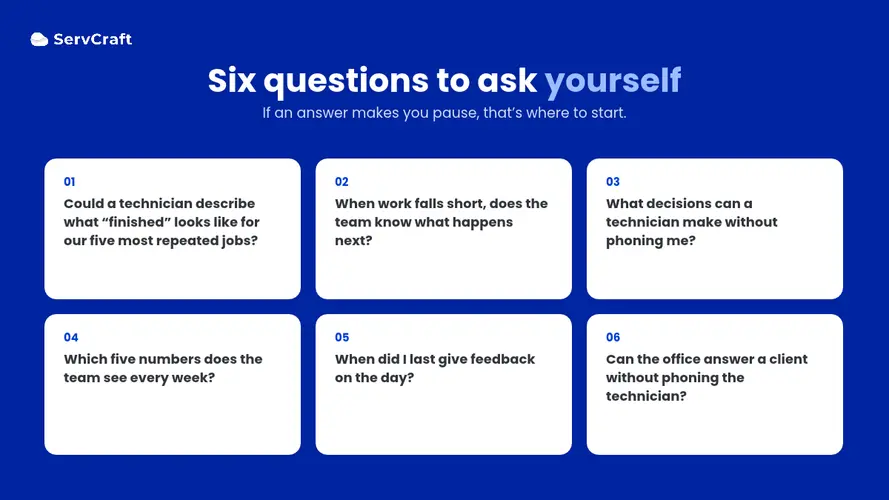
Questions to ask yourself
- Could a technician describe what "finished" looks like for our five most repeated jobs?
- When work falls short, does the team know what happens next?
- What decisions can a technician make without phoning me?
- Which five numbers does the team see every week?
- When did I last give feedback on the day?
- Can the office answer a client without phoning the technician?
Where to start
Pick one area and work on it for two weeks. Leander's point is that a priority is the one thing, and in the live poll the room split almost evenly across all five, so there is no wrong choice. Define "finished" for one job. Write decision rules for what a technician can decide alone. Choose five numbers and show them every Monday. Book one one on one this week.
How ServCraft helps
ServCraft is job management software built in South Africa. More than 1,000 SA trade businesses use it, with 5,000+ teams and 120,000 jobs processed a month. It gives the standard a home:
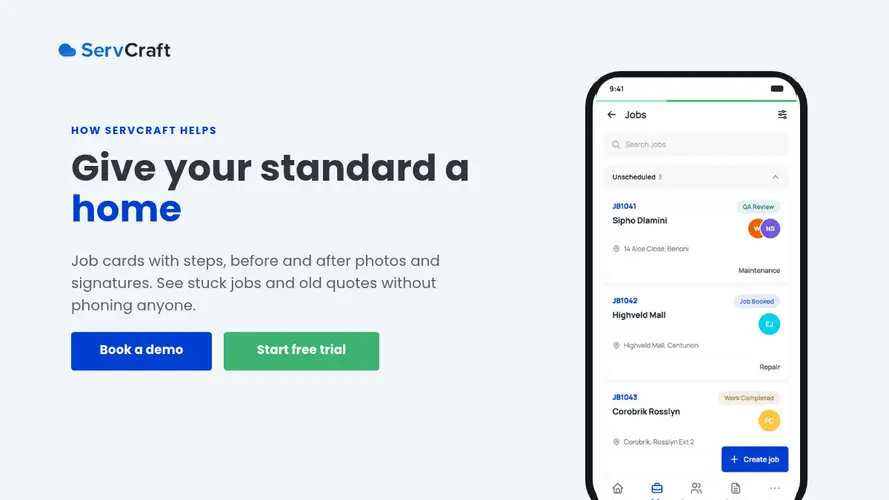
- Job cards:steps, notes, before and after photos and signatures on every job.
- Visibility:see open jobs, stuck jobs and old quotes without phoning anyone.
- Quote to invoice:approved quotes become invoices in one click.
- Van stock:stock tracked across the warehouse and every vehicle.
- Offline app:technicians complete jobs without signal.
- Local support:setup and training from a South African team.
ServCraft does not replace your KPI report. Charles said in the session that a business KPI report is wider than any job software. ServCraft supplies the job data that feeds your Monday meeting, and it does not set your standards for you.What owners say
"If you're gonna lead, you must make sure someone's following."
Kyle Thompson, Owner, 24Seven Plumbing and Electrical.
Frequently asked questions
How do I build a high performing team in a trade business?
Define what finished work looks like, agree the consequence when it is missed, let technicians solve problems before you do, show a handful of numbers weekly and give feedback on the day. Charles Freedman calls this SCORE.
What does SCORE stand for?
Standard, Consequence, Ownership, Results and visibility, Engagement and feedback.
How do I hold technicians accountable without demotivating them?
Write the standard first, then address the work and not the person. Let people own mistakes, fix them and tell you early.
What should a plumbing or electrical business measure each week?
Kyle Thompson's teams track jobs per day, invoiceable hours, materials percentage, callbacks, payments collected on site, Google reviews requested and job admin with photos.
How do I get my team to take ownership?
Ask "what would you do?" before you give the answer, and let them try safe solutions.
Can ServCraft generate my KPI report?
No. It supplies job data such as completed jobs, photos and reports. A full KPI report is wider than the software.
See how it would work for your team
Every trade business runs a little differently. Book a demo and we'll walk through your jobs, quotes and stock with you.
Rather see it for yourself first?
Start a free 14-day trial
, no credit card needed: