Once you run several teams, a fleet of vans and an office, tax stops being something your accountant sorts out in February. It becomes a system: who records what, when, and whether the proof is there when SARS asks.
At ServCraft Mastery on 30 September 2026, chartered accountant Dustin Butler of Sprigg Abbott walked more than 100 trade business owners through 13 tax levers. We've ranked them for businesses with a team behind them, and shown what each one needs from your office.
One owner summed up the night in the chat:
"I wish this sort of overview was available back in the day when I was a new business owner. It would have saved me a bundle in school fees."
Dave, electrical business owner, Durban
Key takeaways
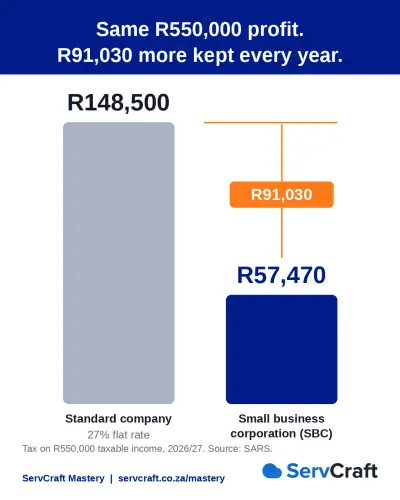
Qualifying for small business corporation rates can keep R91,030 more in the business each year at R550,000 profit.
At your size, the big levers are structure, vehicles, staff incentives, and VAT cash flow.
Almost every lever depends on records your office keeps all year, not in February.
Advice that looks at the business and the owner together finds more.
Before you act:
this summarises a live session. Rules change with every Budget, and every business is different. Figures are for the 2026/27 tax year. Speak to a registered tax practitioner before making changes.
The short answer
A growing South African trade business can lower its tax bill legally by qualifying for small business corporation (SBC) rates, owning and claiming vehicles and equipment properly, claiming staff incentives like the employment tax incentive, managing VAT on the invoice basis, and paying the owner the right mix of salary and dividends.
Every one of these depends on proof. As Dustin put it on the night:
"It's not something that's only done at year end."
1. Get the structure right
Lever 1: Qualify for small business corporation (SBC) rates
This is the first lever Dustin checks with every new client, and usually the biggest.
A company or close corporation that qualifies as an SBC pays tax on a sliding scale instead of a flat 27%.
Gross income of R20 million or less a year
All shareholders are natural persons who don't hold shares in other companies (with limited exceptions)
No more than 20% of income from investment income and personal services combined
[@portabletext/react] Unknown block type "tableBlock", specify a component for it in the `components.types` prop
What it's worth:
on R550,000 profit, an SBC pays R57,470. A standard company pays R148,500. That's R91,030 more kept in the business every year.
Dustin shared the example of an electrical contractor with nine to 10 staff who has kept SBC status for 10 years. His estimate of the total saving: just under R1 million.
Watch out as you grow:
SBC status isn't a registration. You declare it on your return each year, and SARS can query it. Opening a second company, or a shareholder holding shares elsewhere, can disqualify you. Talk to your accountant before you restructure.
Lever 2: Get the salary and dividend mix right
Owners can take profit out as a salary (taxed on the personal sliding scale) or as dividends (20% dividends tax, after company tax). The right answer is usually a mix, and it changes with your structure and your profit.
In Dustin's experience, getting the mix right is worth between R50,000 and R250,000 a year. It's a calculation to run every year, not once.
Probably outgrown:
turnover tax (only for turnover of R2.3 million or less) and VAT on the payments basis (sole proprietors and partnerships only). Worth knowing, but most businesses with a full team are past both.
2. Your fleet and equipment
Lever 3: Your vehicles
With several vans or bakkies on the road, vehicle costs are one of your biggest claims. Three rules matter:
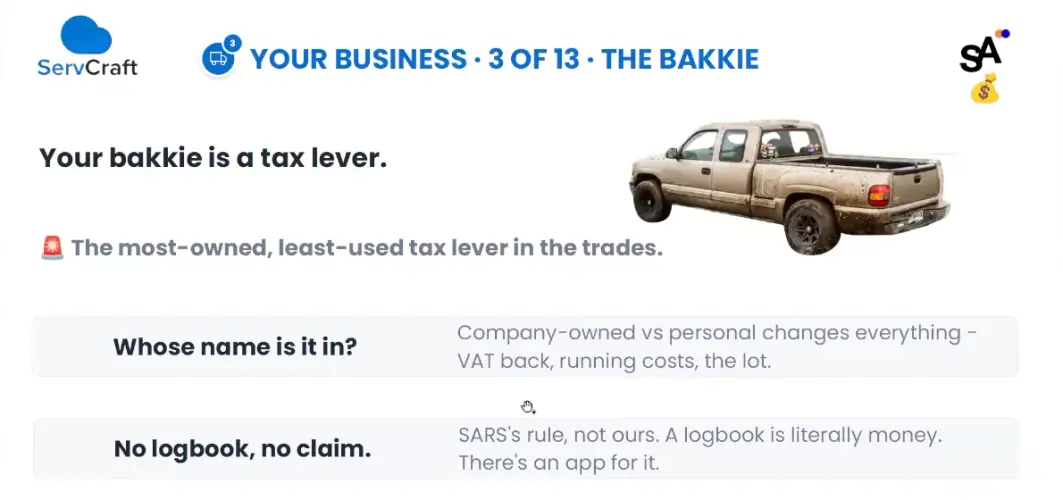
Own them in the business's name.
The business can then claim fuel, maintenance, and wear and tear (usually over five years).Double cabs:
SARS doesn't treat a double cab as a delivery vehicle, so you can't claim the VAT on the purchase.No logbook, no claim.
Keep one per vehicle. Travel from home to your regular place of work isn't business travel.
A question to ask your accountant:
if technicians take vehicles home, is there a fringe benefit to account for in payroll?
As Charles pointed out in the session, a logbook is much easier to keep than it used to be. You already know which customers your teams visited and when.
Where ServCraft fits:
your technicians can log the odometer at the start and end of each trip on the job card, right next to the customer's address, the team and the appointment. Time on site and travelling is tracked too. Your office has the trip record your logbook needs.
See how job cards work
Lever 4: Tools, plant and equipment
When several people buy for the business, invoices end up in the wrong name or go missing. Set one rule: every invoice is made out to the business, as a valid VAT invoice.
Items under R7,000 can usually be deducted in full in the year you buy them.
Larger items are written off over their tax life. Dustin's example: a R50,000 machine over five years gives a R10,000 deduction a year. Some assets qualify for faster write-offs.
3. Your people
Lever 5: The employment tax incentive (ETI)
About three in four businesses in the session had at least one team member under 30.
The ETI reduces the PAYE you pay SARS each month for qualifying employees aged 18 to 29:
Up to R1,500 a month per qualifying employee in the first 12 months, then up to R750 in the next 12
The full amount applies for monthly pay from R2,500 to R5,499, reducing to nil at R7,500
Dustin's example:
five qualifying young employees could cut PAYE by R7,500 a month, around R90,000 in year one. With pay rising toward the top of the band, run the numbers with your payroll provider.
Lever 6: Learnership allowances (Section 12H)
Registered learnerships earn an extra deduction of up to around R40,000 a year per learner, plus a completion allowance. Dustin's example: five registered learners could add at least R200,000 in deductions.
The catch, in Dustin's words:
"There's a lot of compliance and a lot of hoops that need to be jumped through."
Signed agreements and SETA registration must be in place before you claim.
Lever 7: Get part of your skills levy back
If your payroll is over R500,000 a year, you pay a 1% skills development levy. Six staff earning R7,000 a month already passes that line.
Submit a workplace skills plan and annual training report to your SETA by 30 April, and you can claim part of the levy back as a grant. Most businesses pay the levy and never claim.
4. VAT and cash flow
Lever 8: Stop fronting SARS's cash
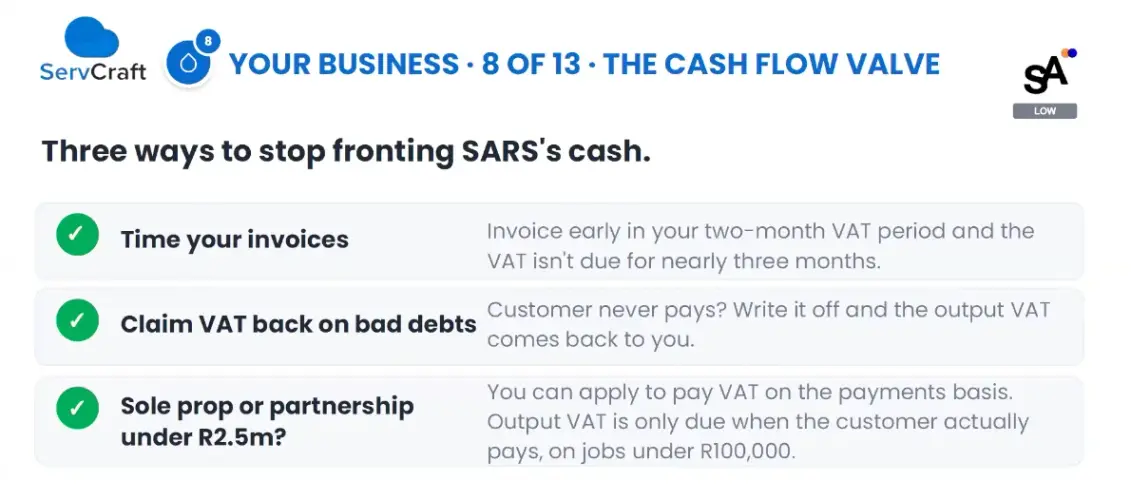
Since 1 April 2026, VAT registration is compulsory over R2.3 million turnover. Most companies pay VAT on the invoice basis:
the VAT is due when you invoice, not when the customer pays.
With hundreds of jobs a month, that gap gets expensive. Your office should:
Track who hasn't paid.
You've already paid the VAT on those invoices.Claim VAT back on bad debts
you've written off.Time invoices
early in a VAT period. They aren't due to SARS for nearly three months.Ring-fence VAT.
Move the VAT portion of every payment into a separate account.
Remember: wages carry no VAT to claim back, so labour-heavy months hit harder.
Where ServCraft fits:
see what's invoiced, paid and outstanding on one screen, send automatic payment reminders, and let customers pay online. Less VAT sits in unpaid invoices.
See how getting paid works
5. You, the owner
Dustin's point: advisers often look at the business or the owner, rarely both.
"It's quite rare that both are looked at."
Lever 9: Retirement annuity contributions
Deductible up to 27.5% of your income, capped at R430,000 a year from 2026/27 (up from R350,000). In the top tax bracket, that's a saving of up to about R193,000. Contribute in your own name, before the end of February. The money is locked in until retirement, but grows tax-free.
Lever 10: Tax-free savings account
Up to R46,000 a year (R500,000 lifetime), with growth never taxed. Dustin recommends it as a personal cash buffer if the business hits a rough patch.
Lever 11: Medical aid tax credits
Fixed monthly credits, now pre-populated on your return. Check whether you or the company pays, because it changes the outcome.
Levers 12 and 13: Home office and turnover tax
A dedicated home office can be claimed, but SARS has asked for photos, and Dustin finds the saving is usually small. Turnover tax is covered above. Both matter more to smaller businesses.
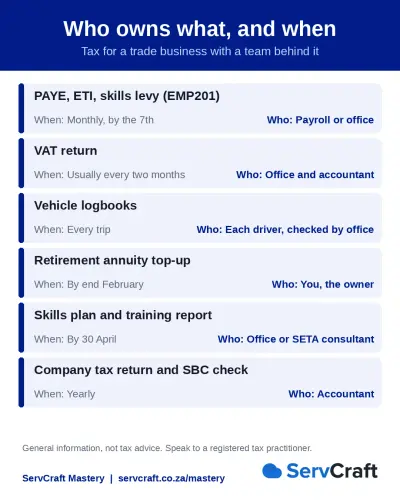
Who owns what, and when
At your size, tax works when the right person owns each step.
PAYE, ETI, skills levy (EMP201):
monthly, by the 7th. Owner: payroll or office.VAT return:
usually every two months. Owner: office and accountant.Vehicle logbooks:
every trip. Owner: each driver, checked by office.Retirement annuity top-up:
by end February. Owner: you.Skills plan and training report:
by 30 April. Owner: office or SETA consultant.Company tax return and SBC check:
yearly. Owner: accountant.
You can't plan tax on numbers you only see once a year
Charles Freedman, ServCraft CEO, opened the session with this:
"Running a trade business is really hard. And the thing no one warns you about is it actually gets harder as you grow."
Tax is part of that. Every lever above depends on records your team creates every day: invoices, purchase orders, job costs, who went where, and who still owes you.
ServCraft is the job management system more than 1,000 South African trade businesses use to run every job, from enquiry to payment. It doesn't do your tax. It builds the records your accountant needs:
Job cards with address, team, appointments, photos, and sign-offs
Time on site and travelling, per job
Job costing: materials and labour against what you charged
Invoices and purchase orders that go to Sage, Xero, or QuickBooks, so nothing is captured twice
What's invoiced, paid, and outstanding, at a glance
ServCraft doesn't replace your accountant. It gives them better information to work with.
Frequently asked questions
What are the SBC tax rates for 2026/27?
0% up to R99,000 of taxable income; 7% of the amount above R99,000 up to R365,000; R18,620 plus 21% of the amount above R365,000 up to R550,000; R57,470 plus 27% of the amount above R550,000.
Can a growing trade business still qualify as an SBC?
Yes, if gross income is R20 million or less, all shareholders are natural persons who don't hold shares in other companies, and no more than 20% of income is investment income or personal services. Check before opening a second company.
What is the VAT registration threshold in South Africa?
From 1 April 2026, registration is compulsory once taxable supplies pass R2.3 million in 12 months. Voluntary registration is possible above R120,000.
Can I claim VAT on a double cab bakkie?
No. SARS doesn't treat a double cab as a delivery vehicle. Running costs can still be claimed for a business-owned vehicle, supported by a logbook.
Does my trade business pay the skills development levy?
If your annual payroll is over R500,000, yes: 1% of payroll, paid monthly. You can claim part of it back by submitting a workplace skills plan and training report to your SETA.
Does ServCraft do tax returns?
No. ServCraft is job management software. It keeps job cards, job costs, invoices, purchase orders, and payment status in one place, and sends invoices and purchase orders to Sage, Xero, or QuickBooks, so your accountant works from accurate records.
Missed the session?
Watch the full 13 Tax Levers for Trades recording, and join the next free ServCraft Mastery session.
See upcoming events
Give your accountant better records
See how your jobs, invoices, and costs come together in one system. Full access for 14 days, no credit card, and a local team to help you set up.
ServCraft is job management software. For tax advice, speak to a registered tax practitioner.
The session expert:
Dustin Butler CA(SA), registered tax practitioner and director at Sprigg Abbott, has advised trade businesses on tax for over 20 years.
This article is general information, not tax advice. Speak to a registered tax practitioner about your business.
About ServCraft Mastery:
free sessions for South African trade business owners on the business problems that get harder as you grow.